Oct 29 · 9:00 a.m. ET
Already registered?
Not registered yet?Register Now

Event day Virtual event

Cloud Native: The AI Stack

The same stack. Infinite possibilities.

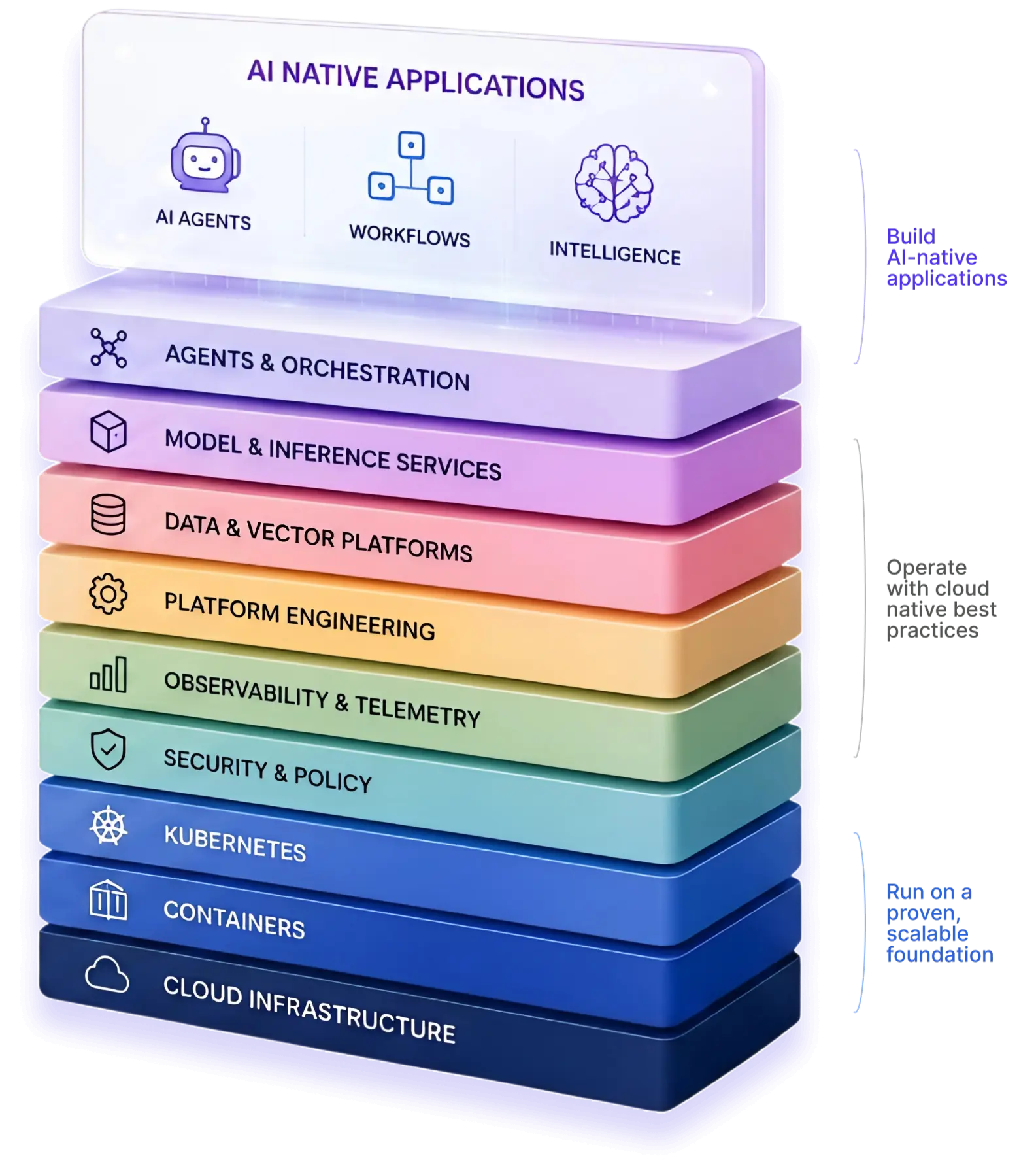
AI-native applications are built on the same technologies, practices, and platforms that cloud native pioneered. From infrastructure to intelligence, it's all cloud native.

Thursday, October 29, 2026 9:00 a.m.–3:00 p.m. ET
The AI stack: AI-native applications built from AI agents, workflows and intelligence, running on agents and orchestration, model and inference services, data and vector platforms, platform engineering, observability and telemetry, security and policy, Kubernetes, containers and cloud infrastructure.
Starts inET
--Days
--Hours
--Min
--Sec
First session
Welcome & Opening Remarks
Thursday, October 29, 2026 · 9:00 a.m.–3:00 p.m. ET
Up next
How Cloud Native Became the AI Stack
9:00–9:30 a.m. ET

About the event

Everybody is building AI. Almost nobody is rebuilding the stack.

Cloud Native Now 2026 is a one-day virtual gathering for the engineers, architects and platform leaders who run the layers AI actually depends on. No hype keynotes. Practitioner sessions, real architectures, real failure modes.

One stack, two workloads

How teams run inference, agents and traditional services on the same Kubernetes substrate — scheduling, GPUs, multi-tenancy and cost control.

Operate what you ship

Observability for non-deterministic systems, policy and guardrails, supply-chain security for models, and the SRE practices that keep agents from going sideways.

Built for decision makers

Platform engineering leaders get the budget, staffing and architecture context to make the next 18 months of AI infrastructure spend defensible.

Who's in the room

  • Platform Engineering
  • SRE & Operations
  • Cloud Architects
  • DevOps Leads
  • ML / AI Platform Teams
  • Security & Compliance
  • Data Engineering
  • CTOs & VPs of Engineering

Attend

Register to attend.

One registration gets you every track live, the full on-demand library, the slide archive, and the post-event research summary from Futurum.

  • All 12+ sessions, live and on demand
  • Speaker slides and reference architectures
  • Live Q&A in every session
  • Post-event Futurum research summary
  • Access to the full Futurum @ KubeCon collection
  • Certificate of attendance for CPE credit

Save your seat

Error: Please enter your first name.
Error: Please enter your last name.
This field is required.
Error: Job title is required.
This field is required.
Error: Your country is required.
By checking “Yes” to process your registration, you agree to the above information being used for processing by Techstrong Group, Inc., and to your information being shared with the event sponsors. You further agree to stay informed about future communications relevant to your professional interests. You may unsubscribe from receiving communications from event sponsors and/or Techstrong Group, Inc. at any time.

By registering you agree that sponsors of sessions you attend may contact you.

01 Schedule

Agenda

Join any session from this page, ask questions in the live Q&A and drop into the sponsor booths between talks. Sessions switch to Watch On Demand as they finish.

Thursday, October 29, 2026 · 16 sessions
Times shown in Eastern Time (ET)
8:55 a.m.
Welcome & Opening Remarks (5 min)LiveOn demand
Alan Shimel, Techstrong Group
9:00 a.m.
How Cloud Native Became the AI Stack LiveOn demand
Alan Shimel, Techstrong Group
9:30 a.m.
The AI Stack CIOs Are Building LiveOn demand
Mitch Ashley, The Futurum Group
AI is entering the enterprise one purchase at a time, and every function is buying. Engineering adopts coding agents, operations adds AI to incident response, and business units turn on agents inside the SaaS they already use. Each purchase is an AI stack decision made before the stack has settled. Mitch Ashley draws on Futurum's CIO & Technology Buyers and AI Software Lifecycle Engineering research to examine what CIOs are assembling, through three lenses. The technology lens covers Futurum's eight-layer model of how the AI stack composes, and why governance and runtime are the least mature layers as agents reach production. The buying lens covers how AI spend is spreading across the organization and what that changes about the CIO's mandate. The work lens covers how software development, platform engineering, and operations are being reengineered as agents take on execution, and why every other department follows the same pattern. Attendees leave with practical tests for evaluating AI platform commitments and a clear view of where control is moving.
10:00 a.m.
Trusted AI Delivery at Scale: Securing Every Artifact from Curation to AWS AgentCoreLiveOn demand
Eldad Assis, JFrog · Arik Yakir, AWS
Our AI supply chain is only as trustworthy as its weakest artifact. As teams race to build and deploy AI agents, every dependency they pull- Python packages, container images, agent tooling- becomes an attack vector. A single poisoned package can compromise everything downstream, and most teams never see it coming. This session walks through how JFrog's platform gives you complete chain-of-custody, from the moment a developer triggers a build in their local IDE to the moment an AI agent runs in production on Amazon Bedrock AgentCore. We'll build a real Strands SDK agent in Kiro IDE, then trigger a single build command. The full supply-chain pipeline unfolds: Curation evaluates every pip package against policy before Artifactory caches it; Artifactory resolves only approved dependencies into the Docker image; Xray scans the resulting container and fails the build on critical vulnerabilities- blocking promotion to ECR. A known-vulnerable dependency in the requirements file stops the pipeline cold; the agent never reaches production.Only when every gate is green does the image land on Amazon ECR and go live on AgentCore. JFrog Curation, Artifactory, and Xray- three layers of trust, enforced automatically, invisible to the developer until something goes wrong.
11:00 a.m.
From Software Supply Chains to AI Supply Chains: Building Trust into Autonomous Engineering SystemsLiveOn demand
Raj Annaladasu, Palo Alto Networks
As engineering teams adopt intelligent assistants and autonomous workflows, software delivery is changing. Systems are no longer made up of just applications and APIs. They now include agents that retrieve information, generate code, use enterprise tools, and make decisions on behalf of developers. Every one of these interactions introduces a new trust boundary. In this session, We'll lshare the architecture and lessons learned from building a cloud-native engineering platform that brings trust, governance, and security to autonomous software delivery. We'll look at how orchestration, long-term memory, knowledge graphs, semantic search, identity, authorization, and policy enforcement work together to help agents operate safely in production. We'll lalso cover the challenges we encountered along the way. Why long-term memory became a security concern. Why controlling what an agent is allowed to do was harder than choosing the right model. Why combining relationship-based knowledge with semantic search produced better results than either approach alone. And why understanding how agents reach decisions is just as important as monitoring their performance. You'll leave with practical design patterns for building secure, observable, and production-ready platforms that can adapt as the technology continues to evolve.
10:30 a.m.
Closing the Security Gap in Agentic DevelopmentLiveOn demand
Mike McGuire, Wiz
As AI transforms software development from hands-on coding to orchestration, traditional security models are falling behind. Human checkpoints are disappearing, while AI-driven workflows introduce and amplify risks at unprecedented speed. This session explores what’s broken in the shift to agentic development and how to secure an AI-accelerated SDLC—so teams can move fast without leaving critical gaps exposed.
12:30 p.m.
Let's Bake A Layered Cake: The Fully Open Source AI StackLiveOn demand
Ram Iyengar, Linux Foundation
A fully open AI stack is something that many enterprises desire. Kubernetes continues to be a great environment to deploy and run agents. For infrastructure and underlying orchestration, there is Kubernetes and the emerging Agent Substrate project. Together, they form the perfect base for hosting agentic workflows. Additionally, Volcano and YuniKorn batch schedulers for Kubernetes. While default Kubernetes is built for microservices, these schedulers are optimized for queuing and distributing massive, compute-heavy AI/ML workloads across GPU clusters. Above these sit the data & model serving pipeline. KServe and Kubeflow allow users to deploy models across frameworks and create a full-fledged MLops platform. With these tools in place, you can build, train, and deploy pipelines directly onto Kubernetes. Next comes execution. Cloud native container runtimes provide the secure sandboxes where AI agents (like OpenHands) can write code, run terminal commands, and test software in total isolation. Examples are Containerd and Podman. Several projects in the cloud native ecosystem can be repurposed to fit the needs of modern AI stacks. Prometheus continues to be the gold standard for monitoring various metrics. Additionally, it can be used for tracking the latency of model responses, GPU utilization, and the intricate multi-step traces of agent workflows. Projects like Kyverno can function as admission controllers. Before an AI agent is allowed to execute a command or modify a system, Kyverno enforces fine-grained, declarative security policies to ensure the agent's actions comply with organizational guardrails. These projects can serve as the start of a compelling AI pipeline without migrating away from existing Kubernetes investments.
2:30 p.m.
AI at Production Scale Needs a Data Platform, Not More PipelinesLiveOn demand
Your first AI agent probably got its data the quick way: a direct database connection, a vector store spun up for the project, a few custom pipelines, and maybe a cache to cut latency. For one agent, or even three, that works. Point solutions are fast to build, easy to understand, and good enough to prove value. Then the requests keep coming, and each new application or agent brings its own connectors, its own copy of customer and transaction data, its own freshness assumptions, and its own security model. Teams with a handful of agents are maintaining dozens of overlapping pipelines, answers drift between agents that should agree, governance becomes a spreadsheet exercise, and nobody can say with confidence which data an agent used to make a decision. This session explores where the hand-crafted approach stops scaling and what a cohesive data platform needs to provide instead. We'll cover how to deliver real-time and historical data through a consistent access layer and how to apply identity, policy, and lineage once rather than per application. We will look at why central governance and metadata will be essential, even when the data remains in its historic location. We will show how to expose data to agents through standard interfaces such as APIs, streams, and MCP. Attendees will leave with a practical architecture pattern and signals for knowing when it's time to make the shift.
12:00 p.m.
Autonomous Databases Maintained by AI on KubernetesLiveOn demand
Kubernetes operators made running a database on cloud native infrastructure routine. They provision, fail over, scale and upgrade. But the hard part of maintaining a database was never the pod; it is the judgment: why this query got slow, whether that index is safe to build, what the cluster needs before the traffic arrives. Meanwhile the databases are multiplying faster than the people who understand them - databases provisioned by AI agents, more data ingested than ever before, and many many more queries per hour to account for, some valid some slopped. I'd like to propose a new autonomous database that closes that loop: a database that observes, diagnoses, tunes and repairs itself. Not a general-purpose model with a shell - engine-specific expertise, encoded as tools and playbooks, running as a control loop next to the operator. This session shows how to get this done on Kubernetes: the reconcile loop, tiered autonomy from read-only to human-approved change, the audit trail and the kill switch. Autonomy is not assumed. It is earned. And in this session we'll be discussing the steps to get there.
12:30 p.m.
Guardrails as Infrastructure: Building Auditable AI Decisioning on Cloud-Native FoundationsLiveOn demand
AI didn't replace the cloud-native stack, it inherited it. As CTO of an AI-driven lending platform, I've watched this play out directly: the hardest problems in deploying automated credit decisioning weren't about the model. They were about identity, policy enforcement, observability, and auditability - the same foundations cloud-native teams have spent a decade building for Kubernetes, now load-bearing for AI.This talk is a practitioner's case study of the infrastructure behind an "auto-decline" system: a live pipeline that decides, in real time, whether a loan applicant is approved, declined, or routed to a human. I'll walk through how we built policy enforcement into a Spring Boot microservices architecture on AWS (EC2, RDS, API Gateway), how we used CloudWatch and structured logging to make every automated decision traceable after the fact, and where human-in-the-loop review had to stay wired into the pipeline rather than bolted on.Attendees will leave with a concrete pattern for engineering guardrails as infrastructure — not as an afterthought - applicable to any team running high-stakes automated decisions on cloud-native foundations, in fintech or otherwise.
2:00 p.m.
Reliability at the Speed of AILiveOn demand
The exponential rise in agentic development means teams are generating and shipping code faster than ever. But that velocity comes at the expense of oversight and reliability. With 82% of organizations reporting AI outages in the last 6 months and 78% more incidents when using AI, the problem is impacting production. Case in point, Meta shipped 220% more code in 2026, but major incidents went up 40% and time spent firefighting went up 70%. The reactive approach to reliability simply isn't enough. AI demands better testing, better verification, and a scalable way to proactively ensure the quality of AI deployments without slowing down. Join Kolton Andrus, CEO and founder of Gremlin, as he shows you how to create an agentic resilience loop to find issues, fix them, and prove resilience before the outage. You'll learn: Why reactive reliability practices aren't enough in the age of AIHow to prevent AI-created failure modes from reaching productionHow to integrate an agentic resilience loop into your software lifecycle
2:30 p.m.
Hiding Veggies in the Pasta: How AI Makes Instrumentation PainlessLiveOn demand
Everyone knows vegetables are good for you, but almost nobody eats enough. Instrumentation is the same: we all agree it matters, yet it's the first thing that's skipped when a deadline hits. AI changes that: the agents writing our code can write the instrumentation too, hiding the vegetables in the pasta. In this talk, Liz will cover how to get agents to add good instrumentation as they code, and how to use AI to turn the resulting telemetry into insights.
11:00 a.m.
Remediation Is Becoming a Software Delivery Capacity ProblemLiveOn demand
AI is making it faster to find and patch security flaws, but someone still has to review, approve, and ship every fix. That work comes out of the same engineering time that builds features. Forty percent of organizations say AI already writes most of the code they merge, and 58% expect AI to build 80% or more of their software within three years (Futurum, 2H 2026). Finding more issues doesn’t mean fixing more. This session walks through how security and engineering teams can redesign the path from a finding to a shipped fix, set risk-based approval rules, and run a 90-day test to see whether AI is saving time or just shifting the work.
11:30 a.m.
Building an AI-Ready Internal Developer Platform on VMware Cloud FoundationLiveOn demand
AI is transforming software delivery, but what does that mean for the architecture of an internal developer platform? As AI agents begin provisioning infrastructure, deploying applications, consuming APIs, andautomating operational workflows, platform teams face a new class of design challenges. Identity, policy, governance, observability, cost controls, and self-service workflows must evolve when a platform serves both human developers and autonomous agents with different needs, permissions, and interactionpatterns. This technical session explores the architectural building blocks of an AI-ready platform. We cover API-first interfaces that agents can call programmatically, policy-driven automation that enforces guardrailswithout manual intervention, Kubernetes as the platform foundation, identity and authorization models for non-human actors, and governance patterns that enable safe agentic workflows at scale. We also address how observability and cost controls must adapt when agents drive automated workflows at high frequency.Through practical architectural examples drawn from real platform implementations, we examine how teams can modernize their internal developer platforms while preserving the reliability, security, and developer experience that made platform engineering successful. Attendees leave with actionable guidance for designing cloud-native platforms ready for the next generation of software delivery, where humans and AI agents collaborate effectively on the same foundation.
1:00 p.m.
Observability in the Agentic EraLiveOn demand
Investigating incidents, correlating traces, and proposing fixes at machine speed is both harder and easier in the agent era. Join Adam Hicks, Sr. Solutions Engineer at groundcover, for a live look at full-fidelity observability built for AI: zero-instrumentation eBPF capture, LLM traffic tracking, and a knowledge graph that turns raw signals into context agents can act on. All of it possible because of groundcover BYOC architecture. A live demo will cover an alert firing in Slack, an agent investigating the root cause from full-fidelity traces, handing the fix to a coding agent, and AI Observability surfacing the cost and performance behind every step.
1:30 p.m.
Navigating AI Tokenomics: Optimizing the Value of Your Agent SpendLiveOn demand
AI agents are becoming increasingly enmeshed across enterprise teams, and spending is climbing faster than the visibility to manage it. Leaders cannot easily see which agents are in use, what tasks teams are assigning them, and how much it all costs. In this session, we’ll introduce Datadog Agent Console—a single workspace to manage AI agents across organizations—and highlight how it connects to deeper cost, performance, and security views.

Can't get into a session? Use Log In at the top with the email you registered with, or the "Join" link in your registration email.

02 Speakers

Meet the speakers

Select a speaker to read their full biography and find their session.

 Alan Shimel

Alan Shimel

Founder & CEO

Techstrong Group

LinkedIn
Alan is founder, CEO & editor-in-chief of Techstrong Group, the company behind DevOps.com, Container Journal, Security Boulevard and Digital Anarchist, as well as co-founder of the DevOps Institute. As such, he is attuned to the world of technology, particularly cloud, DevOps, security and open source. With almost 30 years of entrepreneurial experience, Alan has been instrumental in the success of several organizations. He is an often-cited personality in the security and technology community and is a sought-after speaker at industry and government conferences and events. In addition to his writing, his DevOps Chats podcast, DevOps TV and Digital Anarchist audio and videos are widely followed. Alan attributes his success to a combination of a strong business background and a deep knowledge of technology. His legal background, long experience in the field and New York street smarts combine to form a unique personality. He is a graduate of St. John's University with a Bachelor of Arts in Government and Politics, and holds a JD degree from NY Law School.
 Mitch Ashley

Mitch Ashley

VP Analyst, CIO Tech Buyer & Software Lifecycle Engineering

The Futurum Group

LinkedIn

Mitchell Ashley is a renowned strategist and technology executive. Mitchell has led successful IT, SaaS, and cybersecurity transformations. He’s led multiple teams in developing and bringing to market successful online services, cybersecurity, and networking products and services. Mitch serves as Principal of Techstrong Research where he leads a team of preeminent experts in digital transformation, DevOps, cloud-native, and cybersecurity. In this role, Mitch works with companies to align digital transformation and technology strategies to achieve disruptive goals and high impact results. Mitch is in high demand as a speaker at conferences the world over, and his popular DevOps Chats podcast engaging with digital leaders is one of the most widely followed in the field.

 Alastair Cooke

Alastair Cooke

CTO Advisor

The Futurum Group

LinkedIn

Alastair has made a twenty-year career out of helping people understand complex IT infrastructure and how to build solutions that fulfill business needs. Much of his career has included teaching official training courses for vendors, including HPE, VMware, and AWS.


Alastair has written hundreds of analyst articles and papers exploring products and topics around on-premises infrastructure and virtualization and getting the most out of public cloud and hybrid infrastructure. Alastair has also been involved in community-driven, practitioner-led education through the vBrownBag podcast and the vBrownBag TechTalks."Alastair has written hundreds of analyst articles and papers exploring products and topics around on-premises infrastructure and virtualization and getting the most out of public cloud and hybrid infrastructure. Alastair has also been involved in community-driven, practitioner-led education through the vBrownBag podcast and the vBrownBag TechTalks.

Vikram	 Rathnam

Vikram Rathnam

Research Director, Software Lifecycle Engineering

The Futurum Group

LinkedIn

Vikram Rathnam is Research Director, Software Lifecycle Engineering at The Futurum Group. His research examines how software is built, tested, secured, and operated as AI agents move from assisting developers to doing the work. His coverage includes observability, platform engineering, and the control planes that govern agents. Before joining Futurum, he spent 24 years on the vendor side: ten in engineering at Silicon Labs and fourteen in product and partner strategy, with roles at Cisco, Secureworks, Dell, and CMIT Solutions.

 Liz	Fong-Jones

Liz Fong-Jones

Technical Fellow

Honeycomb

LinkedIn
Liz Fong-Jones is a developer advocate, labor and ethics organizer, and Site Reliability Engineer (SRE) with over two decades of experience. She is currently a Technical Fellow at Honeycomb and previously worked as an SRE on products ranging from the Google Cloud Load Balancer to Google Flights. She is also a co-author of Observability Engineering: Achieving Production Excellence (O'Reilly), whose second edition was published in 2026.
 Itamar Syn-Hershko

Itamar Syn-Hershko

CTO

BigData Boutique

LinkedIn

Itamar Syn-Hershko is the CTO and founder of NeverBlink AI and BigData Boutique. He has spent more than 15 years in the trenches of search and data infrastructure, helping teams get modern data stack well architected and behave nicely in production so they are ready for AI agents to query them. At BigData Boutique he built a consultancy that companies call when their data platforms need to scale or stop falling over. With NeverBlink AI he is now building an AI-native platform that keeps databases resilient and optimized, so fewer teams have to learn those lessons the hard way.

 Rambabu Konda

Rambabu Konda

Chief Technology Officer

Maxbalo Group Inc

LinkedIn
Rambabu Konda is Chief Technology Officer at Maxbalo, where he leads the architecture and engineering behind an AI-driven lending platform, including the automated credit-decisioning systems used to process real loan applications. With 18+ years of experience building cloud-native platforms across Amazon, LevaData, and Maxbalo, he specializes in bringing production grade governance, observability, and reliability to high-stakes automated systems.
 Kolton	Andrus

Kolton Andrus

CEO & Founder

Gremlin

LinkedIn
Kolton Andrus is the CEO and founder of Gremlin, the world's first Reliability and Chaos Engineering platform, helping companies avoid outages and build more resilient systems. Prior, he focused on building and operating reliable systems at Netflix and Amazon. At all companies, he has managed systems at scale, company-wide incidents, and built reliability programs and platforms.
 Raj	 Annaladasu

Raj Annaladasu

Staff Customer Success Engineer

Palo Alto Networks

LinkedIn
Raj Annaladasu is a Staff Customer Success Engineer at Palo Alto Networks, working with large and highly regulated enterprises on cloud-native security, vulnerability management, security automation, and the secure adoption of emerging technologies. His expertise spans Kubernetes, cloud-native application security, software supply chains, infrastructure-as-code, threat modeling, AI security, and securing autonomous engineering workflows in production environments. Raj contributes to the OWASP community across AI security and open-source security initiatives and is the author of the forthcoming book Securing the Agentic AI Supply Chain. He is an active security speaker and practitioner focused on making security controls practical, automated, and measurable across modern software and AI systems.
 Ram Iyengar

Ram Iyengar

OSS Evangelist

Linux Foundation

LinkedIn
Ram Iyengar, Chief Evangelist at Cloud Foundry Foundation. is an engineer by practice and an educator at heart. He was (cf) pushed into technology evangelism along his journey as a developer and hasn’t looked back since! He enjoys helping engineering teams around the world discover new and creative ways to work. He is a proponent of product development and engineering teams that put the community first.
 Mike McGuire

Mike McGuire

Product Marketing Manager

Wiz

LinkedIn
As AI transforms software development from hands-on coding to orchestration, traditional security models are falling behind. Human checkpoints are disappearing, while AI-driven workflows introduce and amplify risks at unprecedented speed.

This session explores what’s broken in the shift to agentic development and how to secure an AI-accelerated SDLC—so teams can move fast without leaving critical gaps exposed.
Eldad Assis

Eldad Assis

Principal DevOps Architect

JFrog

LinkedIn

Eldad Assis has been with JFrog since 2016 and is now Principal DevOps Architect, helping architect the modern JFrog Cloud and driving integrations and partnerships with leading tech companies. He shapes the company’s AI initiatives, developing JFrog AI skills for agentic ecosystems and tools. Before JFrog, he managed multiple teams at NantMobile™, Alcatel-Lucent, and Mind CTI, with extensive experience in DevOps and CI/CD.

Arik Yakir

Arik Yakir

Sr. Solutions Architect

AWS

LinkedIn

Arik Yakir is a senior Partner Solutions Architect at Amazon Web Services (AWS), focusing on ISV partners across the EMEA region. With over 6 years at AWS, and 23 years in the industry, Arik works with technology companies to design and optimize cloud-based solutions, with a focus on AI/ML workloads.

 Bharadwaj Tanikella

Bharadwaj Tanikella

PM - Agent Console

Datadog

LinkedIn
Bharadwaj Tanikella is a Product Manager for Agent Console at Datadog. He focuses on harnessing large-scale datasets to build innovative experiences powered by analytics, machine learning, and artificial intelligence. Today, he works on developing data-driven products that help teams better understand and optimize AI systems while translating advanced technology into tangible business value.
 Jad El-Zein

Jad El-Zein

Technologist, VCF Division

Broadcom

LinkedIn

Technology leader with a 16-year tenure at VMware (now Broadcom) and over 27 years of experience in the IT industry, ranging from driving tech vision, strategy and implementation to leading the research and development of emerging technologies. Speaker, thought leader, mentor, community advocate.

Adam Hicks

Adam Hicks

Senior Solutions Architect

groundcover

LinkedIn

Adam Hicks is a Senior Solutions Architect and technologist at groundcover, where he helps enterprise teams adopt eBPF-based, bring-your-own-cloud observability for Kubernetes and AI workloads. He's spent more than a decade in the observability and cloud-native space, including as a Solutions Architect at Honeycomb.io, as Field CTO and Practice Director at Trace3, where he built the firm's observability and platform engineering practices, and as an early engineer at Morpheus Data through its acquisition by HPE.

03 Sponsor booths

Visit the sponsor booths

Chat live with sponsor experts, watch demos and add resources to My Downloads. Booths are open all day — drop in between sessions.

Register Now
Sponsor boothLive chat

Broadcom

Broadcom Inc. (NASDAQ: AVGO) is a technology leader that designs, develops, and supplies semiconductors and infrastructure software for global organizations' complex, mission-critical needs.

Platform engineeringPrivate cloudVMware Cloud Foundation

On stage: Session details to be announced

Sponsor boothLive chat

Datadog

See how Datadog brings observability to LLM applications, agents and the Kubernetes platforms underneath them.

ObservabilityLLM monitoringKubernetes

On stage: Session details to be announced

Sponsor boothLive chat

JFrog

Talk with JFrog about securing every artifact in the AI supply chain — from model curation and provenance to the agents that run in production.

AI supply chainArtifact securityMLOps

On stage: Eldad Assis in “Trusted AI Delivery at Scale” at 10:00 a.m. ET

Sponsor boothLive chat

Wiz

Meet the Wiz team to see how cloud security keeps pace with agentic development — from code to cloud to runtime.

Cloud securityAgentic developmentCode to cloud

On stage: Mike McGuire in “Closing the Security Gap in Agentic Development” at 11:00 a.m. ET

Booths open in a new tab inside BigMarker. If a booth asks you to register, use the same email you registered for the event with.

04 Resource Hub

Resource Hub

Browse every sponsor's resources, add what you want to My Downloads, then download it all in one click.

  1. 1
    Visit the boothBrowse each sponsor's resources here, then visit the booth to unlock the downloads.
  2. 2
    Add to My DownloadsTap “+ Add to My Downloads” on each item, or “Add all” for the whole booth.
  3. 3
    Download AllMy Downloads is on the rightat the top. Click Download All to get every document and video at once.
Register Now Sponsor Booths Resource Hub0
Cloud Native Now 2026