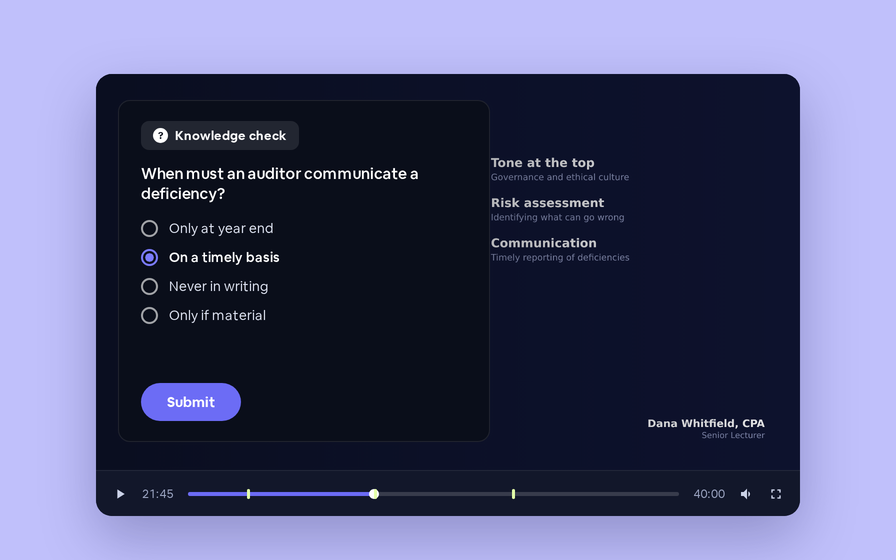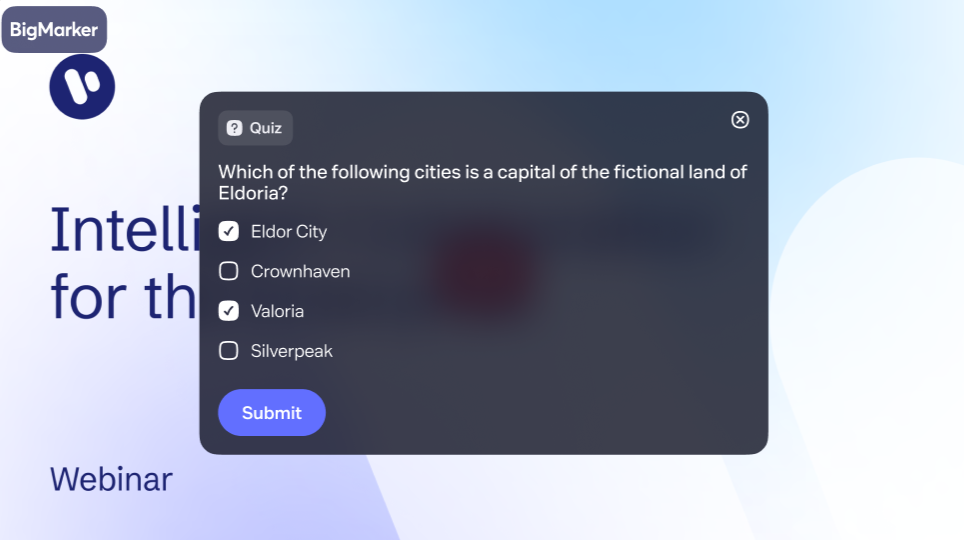
Quizzes place a question inside an on-demand recording at a timestamp you choose. It appears while the viewer is watching, they answer once, and the result — including whether they got it right — flows into your reporting alongside everything else you know about them.
Watching is not the same as learning
An on-demand recording tells you someone pressed play, and how far they got. It cannot tell you whether any of it landed. For compliance, certification and training audiences that gap matters — watch time is not evidence of understanding.
A quiz closes it. Questions appear inside the video at the timestamps you choose, so comprehension is checked at the moment the material is fresh rather than in a survey afterwards.
How it works
Open a recording in the video player editor, switch Quiz on, and add questions. Each one gets its own timestamp, its own answer choices, and its own correct answer.
✦ Quiz
Questions appear in the recording at the times you set
Three questions on one recording, each pinned to its own moment in the video.
| Setting | What it does |
|---|---|
| Timestamp | The hour, minute and second at which the question appears. |
| Answer choices | Mark the correct one, or allow multiple selections. |
| Dismissable | Whether the viewer may close the question and keep watching. |
| Messages | Your own wording for the correct and incorrect responses. |
One answer, and only one
A question is asked once. Once someone has answered it, it never appears for them again — so a viewer who rewatches a section is not re-tested, and a second attempt cannot quietly overwrite the first.
Skipping is deliberate too. If a viewer drags the progress bar past a question, that question is passed over rather than held back for later. The quiz follows the video; it never blocks it.
Results where you already look
Quiz responses are a reporting source in their own right, joined to the member who gave them. For each viewer you get what they answered and whether it was correct, so accuracy sits beside attendance, watch time and registration data in the same report rather than in a separate export.
Questions are served to people with a registration on the session, which is what keeps a response attributable to a named viewer rather than an anonymous one.