
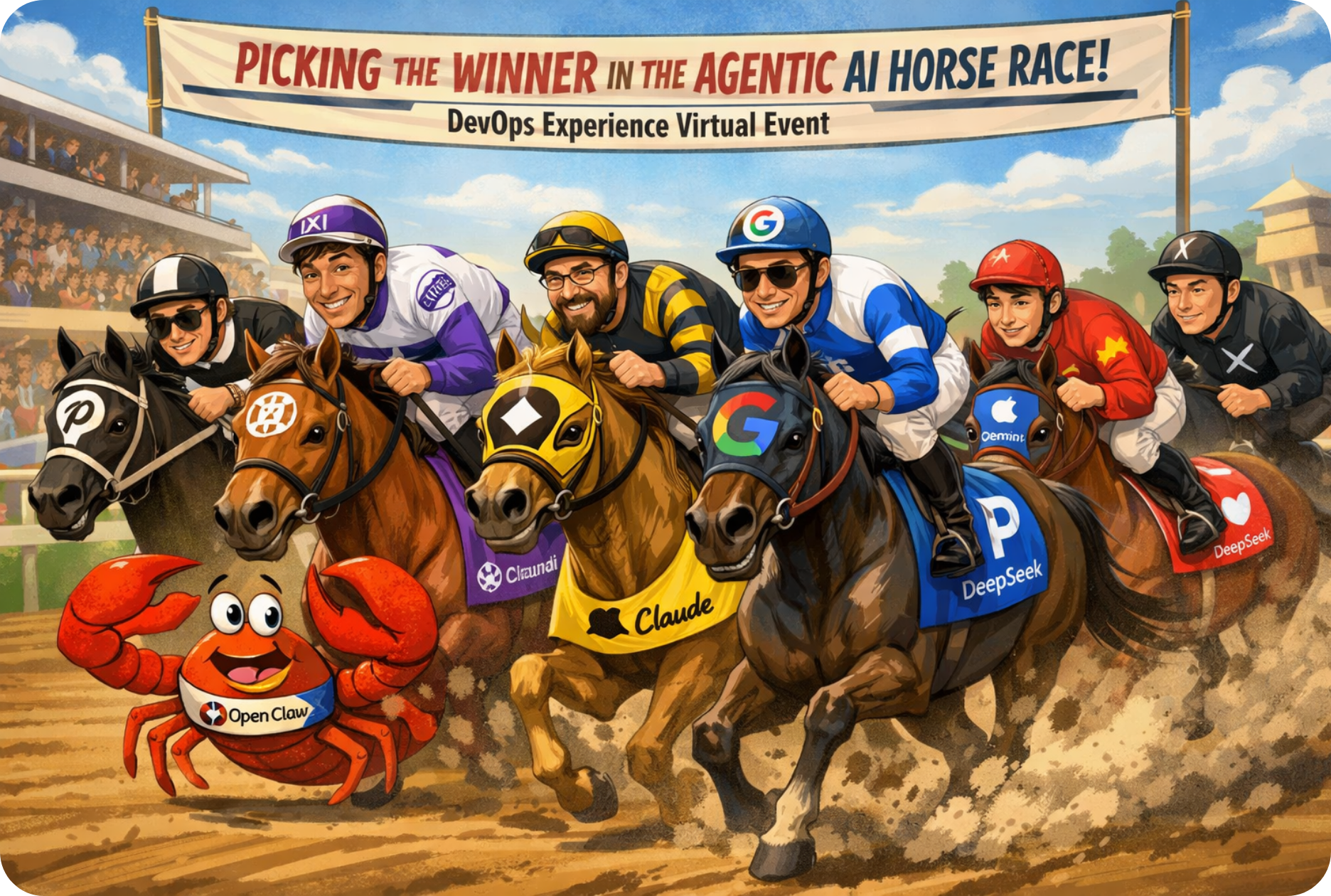
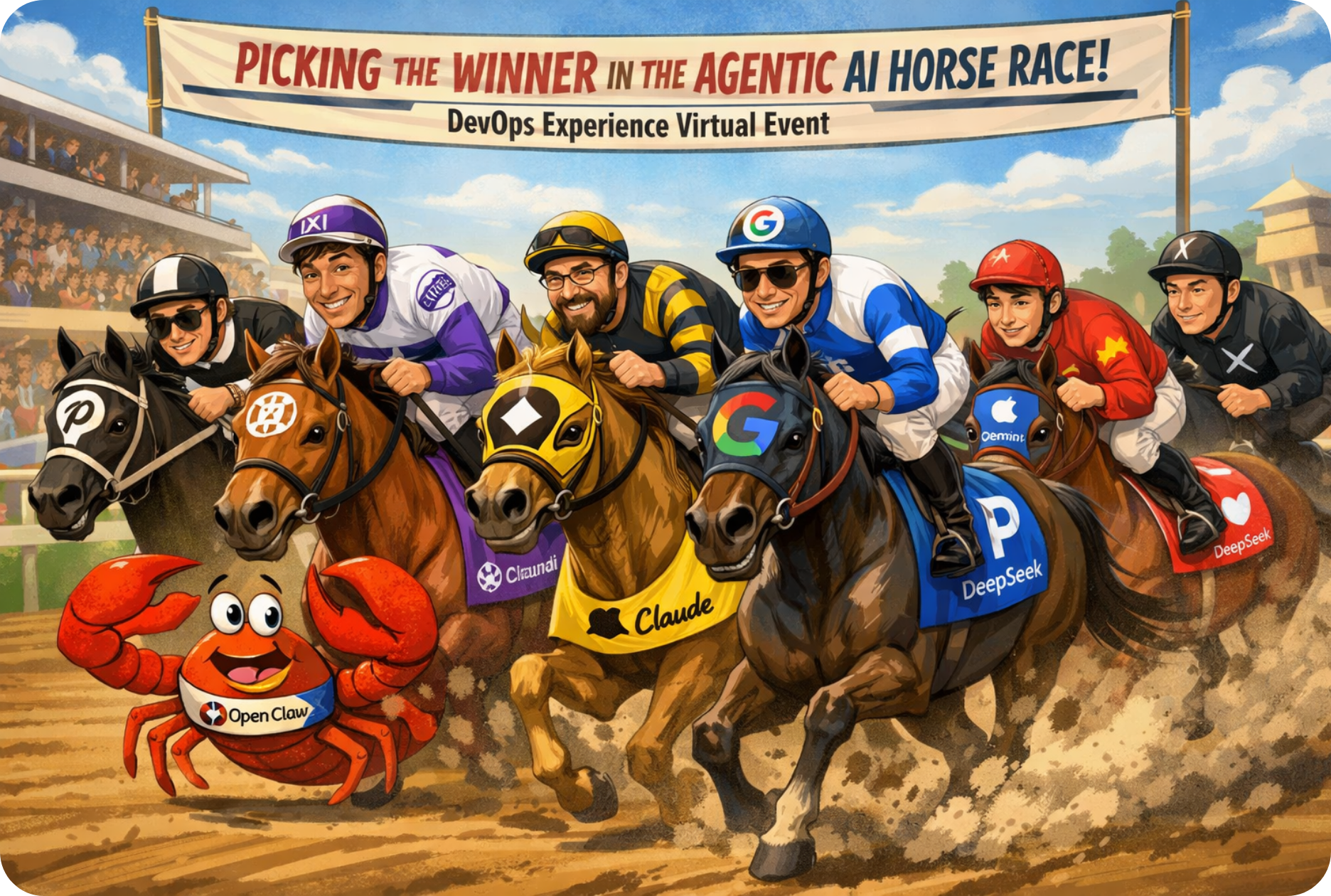
Picking Your Winner in the Agentic AI Race
The race doesn't stop when the event ends. Watch DevOps Experience 2026 sessions on demand and explore expert perspectives on agentic AI, platform engineering, security, and software delivery. Choose a session and watch at your own pace.
Missed a session? Revisit the conversation.
Browse the session library and select Watch Now wherever a recording is available.
Watch the Sessions
Browse the sessions and select Watch Now to play an available recording without leaving this page.
MoreLess
Opening Fireside Chat — The Starting Gate
Before the field even hits the backstretch, someone needs to set the odds. Daniel Newman, CEO of The Futurum Group and one of the world’s top-ranked tech industry analysts, joins Alan Shimel to break down the business case behind the agentic AI race — the CapEx, the monetization math, and why 2026 is shaping up to be the “year of proof” for AI at the enterprise level. It’s the money and market view every DevOps and platform leader needs before they place their own bet on a platform.


MoreLess
Enterprises need an agentic harness: the identity, context, tools, permissions, policies, evaluations, observability and cost controls that connect agents to real work without surrendering control. The harness must allow an organization to evaluate different agents, assign each one an appropriate job, coordinate multiple agents and replace them as capabilities, economics and business requirements change.
In this session, Alan Shimel examines how DevOps is evolving from pipeline automation to governed autonomy. Traditional pipelines execute steps defined in advance. Agentic systems interpret goals, make choices, use tools and potentially take action across the software delivery lifecycle. That shift changes what platforms must manage, who their users are and how enterprises think about security, reliability and accountability.
The winning organization will not necessarily be the one that selects today’s best agent. It will be the one that builds the best harness for continually selecting, governing and changing agents as the race evolves.
What attendees will learn:
Attendees will learn why an agent is more than the model powering it and what belongs inside an enterprise agentic harness. They will see how platform engineering must evolve to support agents as first-class platform users, alongside developers and operators. The session will also provide a workload-based approach to evaluating agents for coding, testing, security, incident response and deployment, while preserving the organization’s ability to change agents without rebuilding its delivery environment.
Key takeaways:
- Evaluate agents against real organizational work, not generalized benchmark standings.
- Treat identity, permissions, context, observability, evaluation and human intervention as parts of the agent platform.
- Select agents by workload instead of assuming one agent or model will win every event.
- Build portability and interoperability into the platform before agent dependencies become deeply embedded.
- Prepare platform engineering to become the discipline that connects agent capabilities to governed enterprise action.

MoreLess
DevOps culture built on human collaboration, shared ownership, and psychological safety faces existential evolution as AI agents automate 30% of engineering workflows by 2030. Core cultural norms around team accountability, knowledge sharing, failure tolerance, and innovation velocity must adapt to autonomous systems that generate code, self-heal pipelines, and make production decisions without human intervention.

MoreLess
This is what the speech will cover:
- The escalating threat landscape: A wave of recent software supply chain attacks including Shai-Hulud, the LiteLLM attack, malicious Trivy packages, and dozens of other campaigns in 2025–2026 - showing attacks are accelerating and becoming routine (13+ campaigns in 8 months).
- Why now: AI agents, MCP servers, IDE extensions, and "skills" are new components in the software supply chain. The shift to an agentic SDLC means software is assembled faster, from more sources, with agents taking autonomous actions - often outside existing security/governance visibility.
- New risks: Assets pulled from anywhere, agents acting without oversight, and governance/security processes disconnected from the actual software supply chain.
- The proposed solution: JFrog's pitch for a unified platform for trusted software - a single system of record spanning people, agents, applications, builds/artifacts, and policies - offering broad ecosystem integrations, curation of upstream packages, and quantified benefits.

MoreLess
Platform engineers are at the center of the enterprise AI shift, but only if the platform is ready for it. In this talk, Luca Galante introduce the Agentic Development Platform (ADP): a reference architecture built around three planes — tooling, path specifications, and agent infrastructure — that gives AI agents the structure they need to actually deliver value in production. Drawing on the concepts from the book Thinking in Platforms, the session shows platform teams how to evolve golden paths into agent-ready specifications and position their platforms, and their organizations, to thrive in the agentic era.

MoreLess
As AI accelerates development cycles and introduces complex new attack surfaces, many security teams feel they are losing ground to automated threats. However, AppSec holds the ultimate defender's advantage: deep context. Because artificial intelligence is only as powerful as the data and context it receives, AppSec’s unique visibility across code repositories, CI/CD pipelines, cloud infrastructure, and identity entitlements positions it perfectly to secure the modern application lifecycle.
In this practitioner-focused session, we will explore how to weaponize this code-to-cloud context to achieve true AI Threat Readiness. We’ll break down how to secure the AI supply chain by identifying critical exposures, mapping real-world exploitability, and accelerating remediation. Finally, a live Wiz demo will bring these concepts to life, showcasing how to surface AI-native risks—like exposed inference endpoints—and automate fixes at machine speed, turning your existing AppSec visibility into a decisive tactical advantage.

MoreLess
As AI accelerates software delivery, it also expands risk, complexity, and attack surfaces. Traditional DevSecOps, while essential, can no longer keep pace with AI-driven systems and evolving threats.
This session introduces Intelligent Continuous Security (ICS) as the next evolution. ICS embeds security across the entire value stream, using Generative AI and Agentic AI to continuously assess risk, enforce policy, and respond in real time.
AI is both the challenge and the solution. It drives unprecedented speed in code generation and system change, while enabling autonomous security agents that monitor behavior, detect vulnerabilities, and initiate remediation at machine speed.
Attendees will learn how to move from reactive, pipeline-based security to proactive, adaptive defense systems. The session presents a practical model for implementing ICS, along with real-world scenarios that illustrate how AI augments security teams without replacing human judgment.
Key insights include how to scale security with AI, reduce emerging risks, and maintain trust through continuous validation and governance.
Security is no longer a gate.
It is an intelligent, continuous system designed to evolve as fast as the software it protects.



Recording not available.
MoreLess
Everyone is racing to pick the winning AI agent. Almost no one is asking what the horse is running on. An agent that acts on unverified pipeline state is indistinguishable from an agent that hallucinated that state. It may win, it may bolt into the parking lot, and you will not know which until the damage is done.
This session introduces proleptic events: delivery events that carry their authored expectation forward, validated and signed before any agent is permitted to act on them. The trust model inverts. Instead of hoping the agent behaves, the substrate guarantees that everything the agent sees has been confirmed against an expectation a human authored, and that every action it takes is traceable back to that expectation.
Using Conduit, the CDF's open-source orchestration platform, we will show an agent operating inside a safe execution space, consuming only validated, signed events, producing a verifiable record of every step. The result is not a smarter agent. It is a track the race can safely be run on; the difference between autonomy you can audit and autonomy you have to apologize for.

MoreLess
Release engineering is evolving beyond traditional automation to address the growing complexity, scale, and speed demanded by modern DevOps environments. As delivery pipelines span multiple tools, teams, and platforms, engineering leaders face persistent challenges around predictability, risk management, and release confidence. "Smarter, Adaptive, and Predictable Release Engineering—Reimagined with AI" explores how artificial intelligence can fundamentally transform release pipelines from rule‑based automation into intelligent, self‑learning systems.
By embedding AI across the release engineering lifecycle, teams can continuously analyze code changes, pipeline signals, test outcomes, and operational feedback to anticipate risk, optimize decisions, and improve flow. Machine learning models enable adaptive quality gates, early anomaly detection, and predictive insights that help teams identify potential failures before they reach production. AI‑driven intelligence also reduces manual triage, shortens feedback loops, and improves coordination across development, testing, and operations.
The result is a release engineering approach that is not only faster, but also more resilient and reliable. This session highlights how AI empowers DevOps teams to move from reactive releases to proactive, data‑driven delivery—unlocking greater confidence, consistency, and control in an increasingly complex software delivery landscape.

MoreLess
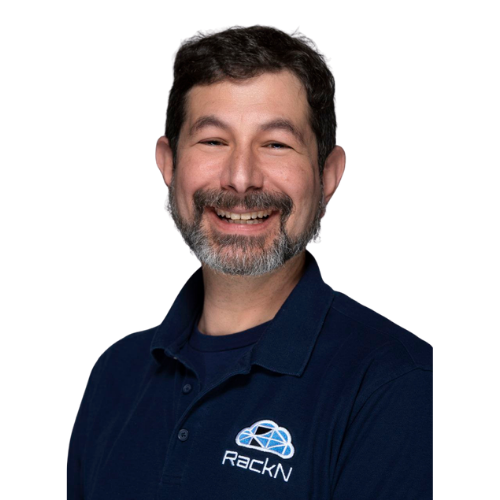
Token anxiety is real because running advanced AI is core to business operations, Can your business manage the cost and supply-chain risk of depending entirely on Frontier LLM providers? Leading enterprises driving a shift to hybrid AI so they can ensure access and manage costs of AI workloads. However, the cost and complexity of running your own systems can be overwhelming.
In this session, we'll review how leading operators are delivering self-managed AI infrastructure at speed and scale using heterogenous platforms. We have practical advice on how you can succeed and what traps to avoid. We'll cover what actually changes when you move from hosted LLMs to bare metal, including the lifecycle management, patching cadence, and process controls that separate teams who deliver from teams who drown. You'll leave with a practical framework for evaluating self-hosted AI and what it takes to run it well.
MoreLess
When we assessed our enterprise cloud estate, the findings were sobering: a 22% Microsoft Secure Score, over 96% of workloads unprotected, privileged access management installed but never configured, and an undersized network firewall carrying the entire security burden. This talk is the honest story of turning that around across a 14-subscription, dual-region Azure platform alongside a production AWS environment.
I will walk through how we rebuilt the platform on a hub-and-spoke architecture with infrastructure as code (Bicep and Terraform), replaced credentials with managed identities and OIDC everywhere, enforced private endpoints and centralized DNS, and layered AI-assisted threat detection on top of native telemetry. I will also cover the organizational side: how we unblocked RBAC bottlenecks between deployment pipelines and security teams, and how we made secure defaults cheaper for developers than insecure shortcuts.
Attendees will leave with a practical maturity roadmap: what to fix first when your score is low, which controls deliver the most risk reduction per engineering hour, and how to measure progress in a way executives understand. This is a case study in security transformation done by a small platform team, not a big-budget program.

MoreLess
Every enterprise already has a software factory, whether they've named it that or not. Code comes in, gets reviewed, built, tested, released, and validated. AI blew past the volume that factory was built for, and most companies never resized the rest.
This session digs into real data from inside Global 2000 engineering orgs, starting with a number that doesn't add up: 92% of teams are confident their AI-generated code is production ready, but 81% say they've seen more production issues since adopting it. Both can't be true. Attendees will see where that gap actually shows up, review, testing, release, validation, and why most companies still can't prove their AI investment is paying off. By the end, they'll have a clearer picture of what it takes to run a factory built for this much code.

MoreLess
Shift-left DevOps had one job: move testing, security, and provisioning tasks earlier so developers caught problems before they became incidents. AI has now done something different — it hasn't moved those tasks earlier, it's taken them away. Code review runs before the PR opens. Test suites get generated from the diff. Vulnerability scanners don't just flag CVEs, they open the fix. IaC gets written from a sentence of intent. Runbooks execute before the on-call engineer finishes reading the page. Every task shift-left once handed to developers is now running behind them, continuously, largely unsupervised.
This talk walks through six core DevOps disciplines — code review, testing, security scanning, infrastructure as code, incident response, and release management — and traces exactly how the task, and the role responsible for it, has changed under AI. The uncomfortable throughline: the people now accountable for supervising these automated decisions are often the same people losing the hands-on reps that once gave them the judgment to catch when the automation is wrong. We'll close with what the job actually looks like now — less implementation, more threshold-setting, exception-handling, and deliberately keeping enough manual practice to stay competent as a check on the system you're running.--

MoreLess
Most teams that add AI scanning to their pipeline quickly face more findings than they can review. That part isn’t surprising. What is surprising is what happens next: remediation gets faster and teams close findings at record speed, yet the number of unresolved critical vulnerabilities continues to climb—sometimes tripling in a year.
It’s a growing disconnect between speed and security, and most dashboards aren’t designed to reveal it.
In this webinar, I’ll unpack the industry data behind this trend, explain why faster remediation doesn’t necessarily mean lower risk, and show you how to spot the warning signs before they surface in a breach report.

MoreLess
AI agents are rapidly evolving from prototypes to production, and it's important to implement structured lifecycle management to ensure reliability, governance, and long-term sustainability. This session will focus on a reference architecture for designing and orchestrating GitOps-driven continuous delivery pipelines to provision, update, and govern Declarative AI Agent infrastructure end-to-end for agent configuration as code, versioning, automated validation, and safe rollback. The talk will discuss how declarative manifests, pull-based reconciliation, and environment-based promotion patterns can enable reproducible agent builds, governed updates, and auditable change history. The pipeline architecture integrates GitOps controllers such as Argo CD and AI agent frameworks such as LangGraph to standardize agent build and deployment workflows, and LangSmith for debugging and monitoring agents. Attendees will also learn about drift detection, policy guardrails, observability signals, rollback strategies, and lifecycle controls required to safely manage behavioral change, reduce deployment risk, and improve reliability, security, and governance for production-grade agent ecosystems.

MoreLess
You didn't build your AI stack. It's being built right in front of you, model by model, framework by framework, orchestration layer by orchestration layer, until the thing you now operate is one you never actually chose. And it's still forming while you're making the calls that matter: where to run it, how to govern it, what to build versus buy. Those decisions are setting defaults you'll fight to unwind later. So the question is simple: does your stack serve your goals, or have your goals started bending to fit the stack? This session shows you where lock-in hides, how observability and control get traded for speed, and how to tell a stack that compounds value from one that compounds cost and risk. You'll leave able to weigh the stack you have against the one you'd build on purpose.

The Agentic AI Horse Race
Agentic AI is changing how teams build, secure, and deliver software. Explore the ideas, approaches, and questions discussed at DevOps Experience 2026.
Keep the Learning Going
Revisit the sessions that matter to your team, catch the conversations you missed, and explore different perspectives on the agentic AI race.
From platform choices and developer experience to security and governance, watch expert discussions at your own pace.
Platform Selection Frameworks
How to evaluate agentic AI tools beyond the hype — cost, security, reliability, and team fit.
Real-World Case Studies
Hear from teams who've deployed agentic AI in production pipelines — what worked, what didn't.
Head-to-Head Comparisons
Side-by-side evaluations of leading platforms across real DevOps scenarios and workflows.
Security & Governance
Guardrails, compliance, and trust — the non-negotiables of enterprise AI adoption.
Industry Leaders & Practitioners
Meet the DevOps leaders, AI practitioners, and platform architects featured at DevOps Experience 2026. Explore their perspectives in the session library.















Thank You to Our Sponsors
Thank you to the sponsors who helped make DevOps Experience 2026 possible. Explore their resources through the links below.


Register to Watch On Demand
Complete the form below to register for on-demand access to DevOps Experience 2026. Browse the session library to see which recordings are available.